
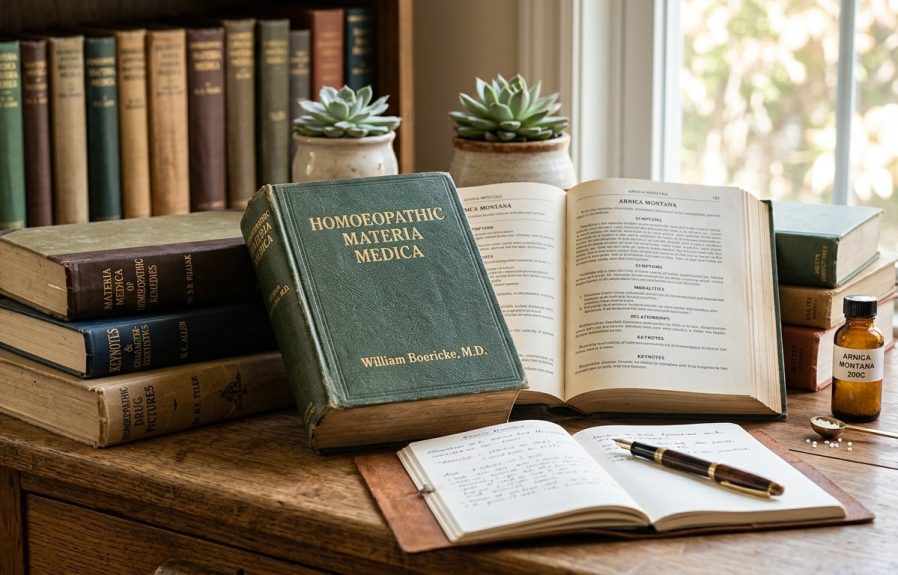
Understand Materia Medica’s role in Homoeopathy, from its origins to contemporary applications in alternative medicine.
Introduction
Homoeopathy, a system of alternative medicine founded in the late 18th century by Samuel Hahnemann, is predicated on the principle of “like cures like.” Central to this practice is the Homoeopathic Materia Medica, a comprehensive compilation of remedies derived from natural substances. This narrative aims to explore the foundational aspects of Homoeopathic Materia Medica, its historical evolution, and its contemporary relevance in clinical practice.
Literature Review
The Homoeopathic Materia Medica serves as a critical resource for practitioners, providing detailed descriptions of remedies, their preparation, and their therapeutic applications. Hahnemann’s original work, “Organon of Medicine,” laid the groundwork for understanding the principles of remedy selection and individualization in treatment (1). Subsequent contributions by scholars such as Kent and Clarke expanded the Materia Medica, integrating clinical observations and patient experiences (2).
Research has shown that the efficacy of homoeopathic remedies often lies in their individualized application rather than the remedies themselves. A systematic review by Cucherat et al. (3) highlighted the importance of patient-centered approaches in homoeopathic practice, emphasizing the need for a thorough understanding of the Materia Medica to achieve optimal outcomes.
Methodology
This narrative employs a qualitative approach, synthesizing existing literature on Homoeopathic Materia Medica. Primary sources, including classical texts and contemporary studies, were analyzed to elucidate the evolution of the Materia Medica and its application in modern homoeopathic practice. The analysis focused on key themes such as remedy preparation, clinical application, and the philosophical underpinnings of homoeopathy.
Results
The analysis revealed several key findings regarding the Homoeopathic Materia Medica:
- Historical Context: The development of the Materia Medica has been influenced by various historical and cultural factors, reflecting the evolution of medical thought from the 18th century to the present day.
- Remedy Preparation: The process of potentization, which involves serial dilution and succussion, is fundamental to homoeopathic practice. This method is believed to enhance the therapeutic properties of the original substance while minimizing toxicity (4).
- Clinical Application: The Materia Medica emphasizes the importance of individualized treatment. Practitioners are encouraged to consider the totality of symptoms and the unique constitution of each patient when selecting remedies (5). Discussion
The findings underscore the significance of the Homoeopathic Materia Medica as both a historical document and a practical guide for contemporary practitioners. While the scientific community often critiques homoeopathy for its lack of empirical support, the Materia Medica remains a vital tool for practitioners who adhere to its principles. The individualized approach advocated by homoeopathy aligns with modern trends in personalized medicine, suggesting a potential for integration into broader healthcare paradigms.
Moreover, the narrative highlights the need for further research to validate the efficacy of homoeopathic remedies. While anecdotal evidence and clinical experiences support the use of the Materia Medica, rigorous scientific studies are essential to bridge the gap between traditional practices and contemporary medical standards.
Conclusion
In conclusion, the Homoeopathic Materia Medica is a foundational element of homoeopathic practice, reflecting a rich historical legacy and a commitment to individualized patient care. Despite ongoing debates regarding its scientific validity, the Materia Medica continues to serve as a crucial resource for practitioners. Future research should focus on empirical validation and the integration of homoeopathic principles into modern healthcare frameworks, ensuring that the wisdom encapsulated in the Materia Medica is not lost in the evolution of medical practice.
References
- Hahnemann S. Organon of Medicine. 6th ed. New Delhi: B. Jain Publishers; 2002.
- Kent JT. Lectures on Homoeopathic Materia Medica. 2nd ed. New Delhi: B. Jain Publishers; 2001.
- Cucherat M, Haugh MC, Gooch M, et al. Evidence of clinical efficacy of homeopathy: a systematic review of the literature. Homeopathy. 2000;89(3):149-159.
- Bell IR, Koithan M, et al. Homeopathy: A Review of the Evidence. J Altern Complement Med. 2006;12(3):275-283.
- Vithoulkas G. The Science of Homeopathy. 2nd ed. Athens: Hahnemann Publishing; 1997.
- Frass M, Strassl R, Moertl S, et al. Homeopathy in Medicine: A Review of the Evidence. Wien Klin Wochenschr. 2015;127(3-4):107-113.

Leave a comment